
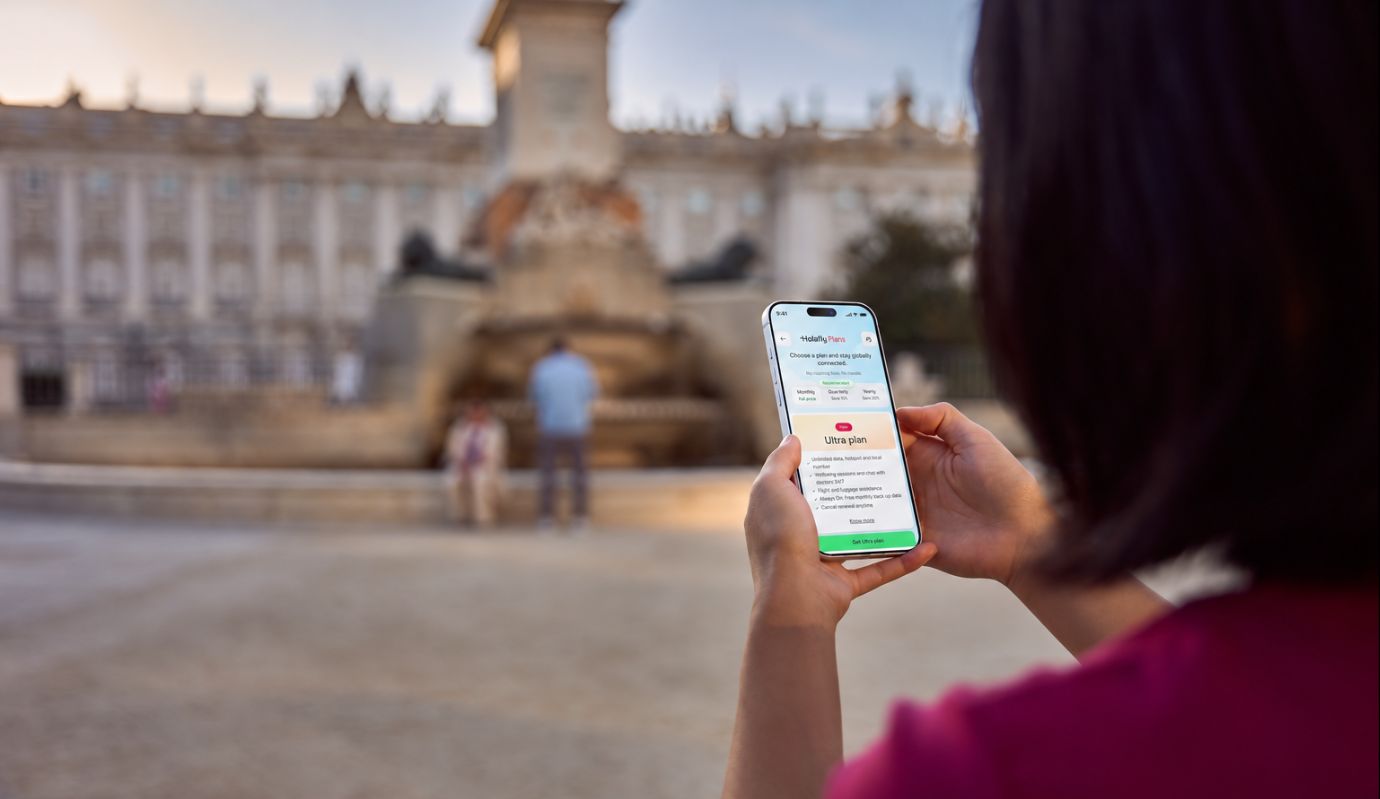
Reliable internet is probably the most important must-have for workation and bleisure travellers. We spoke to Carlos Heredero, Head of Operations at Holafly, about the benefits of eSIM cards, how they work, and the trend towards data volume rather than calls.
Carlos, what works better for bleisure travellers and remote workers with an eSIM card than with other ways of getting online?
Whether it’s for a meeting, accessing work documents or finding your way around a foreign city: being able to use mobile internet straight after arrival gives you much greater flexibility whilst on the move. With an eSIM, travellers can ensure they’re online at their destination even before they set off, without having to buy or swap a physical SIM card once they’re there. This is particularly handy for frequent travellers who regularly move between different countries. Depending on the tariff, the costs for mobile data are also easier to calculate than with traditional roaming. For people who work abroad, features such as hotspot usage are also handy, as they allow them to connect their laptop or other devices to the mobile internet. What’s more, the possibilities now extend beyond simply providing mobile data; some systems combine this with support for flight issues and lost luggage, as well as access to digital health and wellness services. The aim is to ease some of the everyday challenges faced by people spending extended periods abroad.

What exactly distinguishes an eSIM from a physical SIM card?
It is important to distinguish between the eSIM technology itself and the services offered by individual providers. In principle, an eSIM also enables conventional phone calls and text messages. However, many travel eSIM plans focus primarily on providing mobile data. One reason for this is that travellers abroad are increasingly using internet-based services such as WhatsApp, Microsoft Teams or Zoom to communicate with one another. This allows voice and video calls to be made via a mobile data connection without the need for an additional local phone plan. With a compatible dual-SIM smartphone, travellers can often continue to use their usual phone number for traditional calls and text messages whilst simultaneously using an eSIM for mobile data. However, charges from their home mobile network provider may still apply. Some travel eSIM plans also offer additional features for receiving and sending messages.
Why is there only data and no calls?
It is important to distinguish between the eSIM technology itself and the services offered by individual providers. In principle, an eSIM also enables standard phone calls and text messages. However, many travel eSIM plans focus primarily on providing mobile data. One reason for this is that travellers abroad are increasingly using internet-based services such as WhatsApp, Microsoft Teams or Zoom to communicate with one another. These allow voice and video calls to be made via a mobile data connection without the need for an additional local phone tariff. With a compatible dual-SIM smartphone, travellers can often continue to use their usual phone number for traditional calls and text messages whilst simultaneously using an eSIM for mobile data. However, charges from their home mobile network provider may still apply. Some travel eSIM plans also offer additional features for sending and receiving messages.
Does Holafly offer eSIMs around the globe? Where do they not yet work?
We currently offer travel eSIMs for more than 200 destinations worldwide, covering most major international travel markets. For travellers visiting multiple countries, Holafly’s Ultra Plan offers unlimited mobile data in more than 160 destinations as part of a single subscription. Availability may vary depending on the destination and product. We therefore recommend checking the current network coverage and verifying your device’s compatibility before you travel. This is particularly important when travelling to more remote regions.
HolaCoins as a loyalty programme – what does it offer?
The HolaCoins loyalty programme is aimed at frequent travellers and digital nomads who regularly need mobile internet whilst abroad. Users earn points through eligible purchases and referrals, which they can then redeem for discounts on future eSIM purchases or for subscriptions such as Holafly’s Ultra Plan. For ‘bleisure’ travellers who are on the move several times a year, the programme thus offers the opportunity to reduce their mobile data costs in the long term.
There are also mobile phones on which eSIMs do not work. Is there a solution for these too?
Yes. Travellers whose smartphones do not support eSIM technology can still use a physical SIM card from a local mobile network operator or a mobile Wi-Fi router to access the internet whilst abroad. It is important to check whether your smartphone is compatible with the technology before purchasing a travel eSIM. Support may vary depending on the device model and market. For compatible devices, digital activation offers greater convenience, whilst travellers with older smartphones can still use traditional alternatives.
Thank you very much for the interview, Carlos!
Photos: Holafly