
“For the first time, the recent Blend_it! initiative summit in Frankfurt brought together all the different stakeholders. Together, they aim to promote more ‘bleisure’ and ‘workations’ and have developed eleven courses of action.” Sylvie Konzack
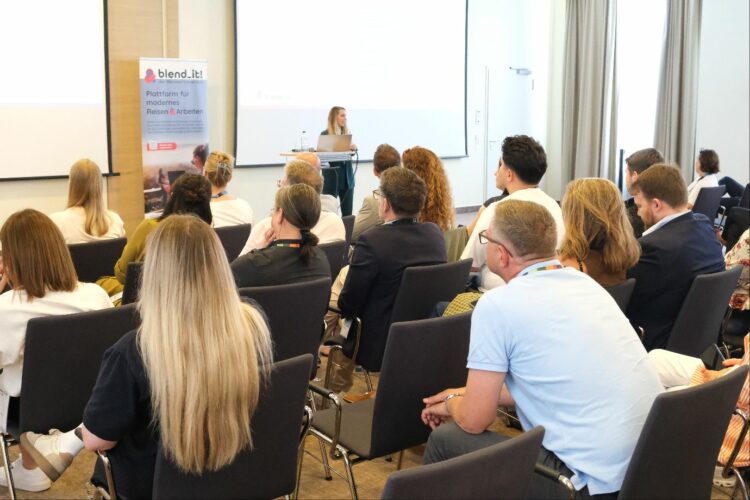
Whether travel managers, hotels, destinations, airlines or car hire providers – for the first time the two day summit organised by the Blend_it! initiative in July in Frankfurt at the Best Western Plus Welcome Hotel Frankfurt brought together a wide range of stakeholders keen to create a framework for more bleisure and workations. At the same time, it soon became clear that they were all facing different challenges, which in turn led to many revelating moments for everyone involved.
This is because corporate travel managers have complained not only about legal uncertainties and the high level of red tape, but also that bleisure offers have so far been barely reflected in the booking process. At the same time, they noted how much some employees are now prioritising the leisure aspect in their business travel planning.
Destinations complained that there has so far been too little interaction with tour operators and others regarding bleisure offers, and that they themselves still too often distinguish between leisure tourism and business travel within their own organisations. Hotels, meanwhile, highlighted in particular the cumbersome booking processes and the need to handle corporate rates appropriately.
Yet there was a strong drive to identify and implement solutions together. One company, for example, reported on a policy that has been successful for years, stipulating that the time of the ‘bleisure’ stay must not exceed the business stay in duration, so that the trip remains business-related and no financial benefits arises. Furthermore, the return journey must always be from the business destination to the primary place of work or home, and business and private expenses must be clearly separated in the accounts.
The Moa Congress Hotel in Berlin presented its new co-working space, for which it has put together its own packages for bleisure and workations. The hotel argued that travel managers should incorporate such establishments – which already offer specialised packages – into their systems in an even more targeted manner, so as to better meet their employees’ needs in this area.
Developing standards together
The two studies presented at the summit – by the Bleisure & Workation Monitor and the Bavarian Centre for Tourism (BZT) – also provided plenty of revelating moments (as we reported earlier). As the first research projects on this topic in Germany, they highlight the already high demand for bleisure and workations in Germany, along with the motivations and preferences behind them. Furthermore, they highlight the current lack of offerings from tourism service providers.
Based on the findings and the challenges identified across the board, the summit participants in Frankfurt ultimately developed, through interdisciplinary workshops, eleven areas for action, which are now to be implemented jointly. These include legally compliant model regulations for companies, the incorporation of bleisure and workations into travel policies, and the removal of legal and tax barriers; furthermore, technical integration into existing booking and accounting systems, as well as a closer collaboration between companies and their departments (HR, Compliance, Finance), technology providers and destinations – not least to foster more positive examples.
The 11 areas of action in detail:
1. Establish legal certainty, right down to a usable template
2. Incorporate ‘bleisure’ into the policy
3. Consistently distinguish between business and private travel
4. Set up a booking platform with split-logic
5. Integrate ‘bleisure’ and ‘workation’ into the existing booking structure
6. Create a legally compliant channel to travellers
7. Use MICE (Meetings, Incentives, Conventions, Exhibitions) and destinations as a gateway
8. Design offers to be small-scale, flexible and adaptable
9. Build acceptance through consistent wording and education
10. Provide evidence: pilot schemes and case studies rather than further research
11. Simplify the political framework
Jens Schließmann, Managing Director of the business travel association VDR, which launched the initiative together with the GCB, emphasises: “Companies today face the challenge of enabling new freedoms whilst ensuring compliance, duty of care, and cost-effectiveness. To achieve this, we need common standards and practical solutions. The summit has shown that we can only develop these by working together with all stakeholders.” On 28 October 2026, the initiative also plans to present a white paper as part of a webcast.
Sylvie Konzack …
… has already taken part in numerous specialist conferences on the topic of bleisure and workations this year. When *Bleisure Traveller* magazine was launched in 2018, this was still just a pipe dream.
Photos: © Konzack, Initiative Blend_it!